

When you’re trekking through the humid heat of a South Carolina summer or navigating the stagnant backwaters of the Lowcountry, “clean-looking” water is a total myth. Most filters stop at bacteria, but this Grayl GeoPress review looks at a true water purifier for backpacking.
If you need to turn “swamp soup” into drinkable water in seconds, this is the heavy hitter of your gear closet. Using a Grayl GeoPress review as your guide, you’ll see why this “one-press” system is a game-changer for those who don’t want to mess around with squeeze bags or chemical tablets.
Purifier vs. Filter: The Tech Behind the Press
Most hikers in the Southeast rely on hollow-fiber filters. While those are great for the mountains, they don’t touch viruses or heavy metals. The GeoPress uses electroadsorption and activated carbon to pull out the nasties: viruses, bacteria, protozoa, and even chemicals.
For the Skilled Outdoorsman, this is a “Global Protection” tool. Whether you’re worried about agricultural runoff in a Piedmont creek or a Norovirus outbreak at a crowded AT shelter, the GeoPress handles it all with one 8-second press.
The “Press” Experience: Speed vs. Effort
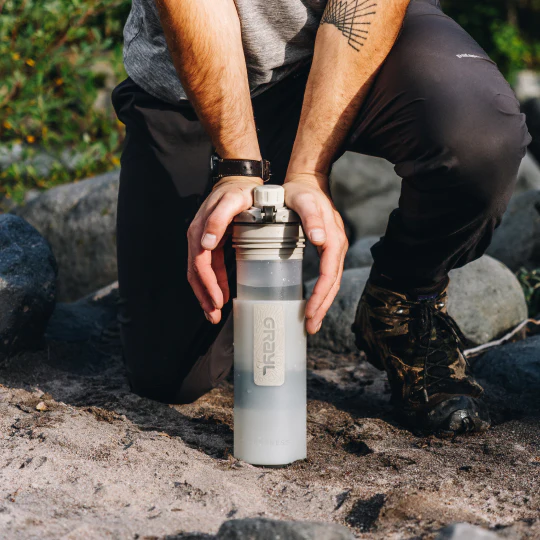
The “Fill, Press, Drink” system is the closest thing to magic in the woods.
- Fill the outer cup to the line.
- Press the inner sleeve down using your body weight.
- Drink directly from the spout.
💡 SKILLED PRO-TIP Water is your first priority, but power is your second. Once you’ve secured your filtration kit, see how we managed long-term emergency power during our latest grid-down simulation.
Read the Jackery 2000 Plus Field Report →
There’s no sucking through a straw or wrestling with a fragile bag. However, in our Grayl GeoPress review testing, we found that as the cartridge nears the end of its 350-cycle lifespan, that 8-second press can turn into a 30-second workout. In the humidity of the South, you will break a sweat if your filter is getting clogged with silt.
Grayl GeoPress vs Sawyer vs LifeStraw
How does the “King of Purifiers” stack up against the ultralight kings for ultralight trekking in the Southeast?
| Feature | Grayl GeoPress | Sawyer Squeeze | LifeStraw Peak Solo |
| Protection | Purifier (Viruses +) | Filter (Bacteria) | Filter (Bacteria) |
| Dry Weight | 15.9 oz | 3.0 oz | 1.7 oz |
| Treatment Time | 8-10 Seconds | 45-60 Seconds | 30-45 Seconds |
The Southern Reality: Handling Silt and Weight
Let’s be honest—at nearly a pound empty, the GeoPress is a “chunk” in your pack. For a weight-conscious kit, this is a significant trade-off. However, the peace of mind you get when filtering from a stagnant pond is often worth the extra ounces.
The Silt Issue: If you are filtering from a silty Southern river, the GeoPress cartridge will clog faster than a hollow-fiber filter. Unlike the Sawyer, you cannot back-flush a Grayl. Once it’s clogged, you have to buy a new $30 cartridge.
Pro-Tip: If the water is really “chunky,” pre-filter it through a bandana or a coffee filter. This simple trick can extend the life of your expensive Grayl cartridge by 20% or more.
Durability: Built Like a Tank for Solo Hiking Gear
The GeoPress is arguably the most durable piece of solo hiking gear you’ll ever own. It’s rated to survive a 10-foot drop onto concrete. The “TopoGrip” rubber handles make it easy to use even when your hands are slick with DEET or sweat. This ruggedness is a major highlight in any Grayl GeoPress review.
Verdict: Is the GeoPress Right for You?
To wrap up this Grayl GeoPress review, this isn’t the filter for a 2,000-mile thru-hike where every ounce is counted like gold. But if you are a weekend warrior exploring “sketchy” water sources, or if you want one device that works for both the woods and international travel, this is the gold standard. It’s the ultimate water purifier for backpacking when failure (and a stomach virus) isn’t an option.
Check out our complete guide on the best water filtration devices to see where the Grayl ranks for the upcoming season.